Our impact on sickle cell disease
Every year, more than half a million babies are born with sickle cell disease. In many parts of the world, a diagnosis in the first weeks of life can mean the difference between life and death.
We are helping bring accurate diagnosis closer to the children who need it most.
© iStock/Just_Super
Global overview of disease burden
Once considered a “rare” disease because of its relatively low prevalence in North America and Europe, sickle cell disease is actually one of the most common genetic blood disorders in the world, affecting nearly eight million people. Sickle cell disease occurs when a child inherits a sickle cell gene from both parents. People who inherit only one sickle cell gene have sickle cell trait, which usually causes no symptoms but can be passed on to their children.
What makes sickle cell disease unusual is not its prevalence, but who it affects. Nearly 80% of people living with the disease are in sub-Saharan Africa, and the sickle cell gene is most common among people of African, Mediterranean, Middle Eastern and Indian ancestry.
Sickle cell disease can cause extreme pain episodes and life-threatening complications including severe anaemia, stroke and serious bacterial infections. Without early diagnosis and access to basic care, mortality remains extremely high.
Curative treatments, including gene therapies, are beginning to emerge. However, they remain prohibitively expensive and inaccessible to most people living with sickle cell disease. Early diagnosis and timely treatment remain the most effective way to reduce illness and prevent premature deaths.
The importance of newborn screening
In many high-income countries, newborn screening for sickle cell disease is routine, allowing babies with the disease to begin treatment before symptoms develop. Yet in many low- and middle-income countries, where the vast majority of affected babies are born, many children are diagnosed only after repeated, life-threatening complications – if they are diagnosed at all.
That makes newborn screening one of the highest-impact interventions available.
Diagnosing the disease at birth can save lives by enabling timely preventive care and treatment, including malaria prevention, preventive antibiotics to reduce the risk of life-threatening bacterial infections, routine immunisation, and caregiver education that empowers families to recognise warning signs, seek prompt medical care and support their children’s health over the long term.
“In many parts of the world, a diagnosis in the first weeks of life can mean the difference between life and death.”
Our sickle cell agreement
Learn more about how we are helping more children access early diagnosis for sickle cell disease.
Projected impact by 2028
6m
additional people to gain access to testing
Case study
Bringing laboratory-quality diagnosis closer to patients
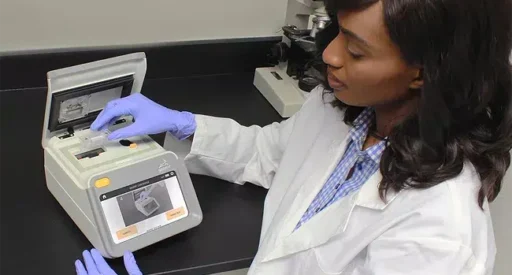
In many low-resource settings, diagnosing sickle cell disease requires trained technicians and complex laboratory equipment that is expensive, difficult to maintain and often unavailable outside major hospitals. As a result, children may wait months or years for an accurate diagnosis. Many are never diagnosed.
The Gazelle® diagnostic platform was designed to address this challenge. The compact, portable device delivers laboratory-quality results in around eight minutes from a finger-prick blood sample, making accurate diagnosis possible at the point of care without the need for specialised laboratory infrastructure or intensive training. This allows healthcare workers to diagnose sickle cell disease during a single clinic visit, rather than sending a blood sample to a distant laboratory and waiting days or weeks for a result.
By reducing the need for costly infrastructure, the technology has the potential to expand access to timely diagnosis in remote and underserved communities. Gazelle® is accurate and easy to use in low-resource settings, and can also test for other conditions including malaria, hepatitis and COVID-19.
Partnering with Hemex Health
To help accelerate access to the Gazelle® diagnostic machines, MedAccess provided a US$2.5 million working capital facility – a type of loan – to Hemex Health, supporting manufacturing and expansion across India, the Middle East and sub-Saharan Africa. The partnership is expected to improve access to testing for approximately six million people by 2028, helping more children receive an earlier diagnosis and access to appropriate care.