Our impact: Malaria
After years of steady gains against malaria, progress has stalled. More than 282 million cases were reported in 2024, and 610,000 people died—more than the year before. MedAccess is working to accelerate access to innovative new tools to protect people from malaria.
© iStock/Dr_Microbe
Global malaria overview
Malaria is caused by a parasite transmitted through the bites of infected female Anopheles mosquitoes. Approximately 95% of malaria cases and deaths occur in sub-Saharan Africa, and 75% of deaths occur in children under five. Malaria is both preventable and treatable, but without treatment, it can be fatal or cause serious health complications, particularly for babies, children and pregnant women.
Until recently, the world had seen strong progress against malaria: mortality and incidence rates had steadily declined since 2000, a growing number of countries had eliminated the disease, and a range of health tools, including insecticide-treated nets, indoor residual spraying, preventive treatments and a new vaccine, were protecting more people.
The challenge
But a combination of new challenges is threatening progress. Resistance to artemisinin, the most commonly used drug to treat malaria, has been reported in southeast Asia and parts of Africa, and mosquitoes are also rapidly developing resistance to the main insecticides used to repel and kill them. Climate change is driving malaria-transmitting mosquitoes to new regions, and the transmission season is getting longer.
To get ahead of malaria and address these new threats, countries need access to innovative, affordable prevention tools, treatments and vaccines.
“Malaria is not driven by a lack of solutions. The tools, knowledge and experience to end malaria already exist. What is needed now is predictable, sustained financing to ensure existing interventions reach those most at risk.”
Joy Phumaphi
Executive Secretary, African Leaders Malaria Alliance
Our malaria agreements
Learn more about how we are accelerating access to products that tackle malaria:
Impact as of end-2025:
15.6m
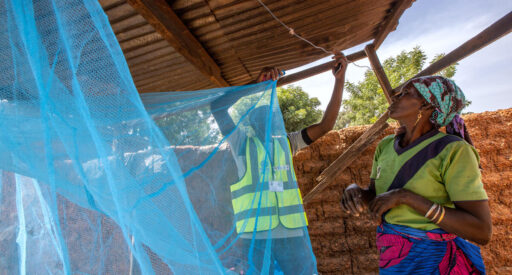
malaria cases averted with BASF nets
2.6m
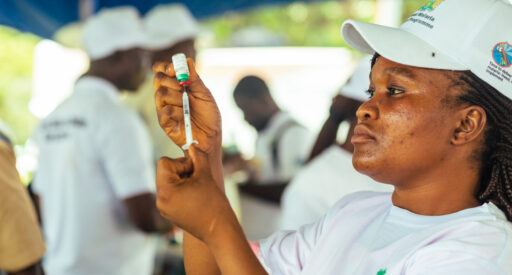
children vaccinated with the RTS,S vaccine
42,300
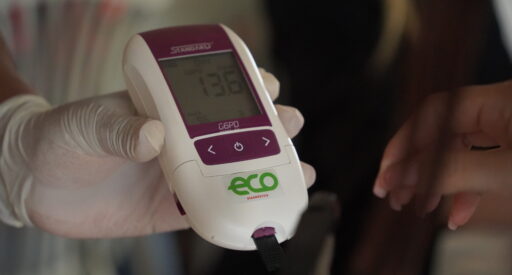
P. vivax malaria relapses averted
Case study
Introducing the world’s first malaria vaccine
In 2021, MedAccess partnered with Gavi, the Vaccine Alliance, and GSK to maintain production of RTS,S, the world’s first malaria vaccine. RTS,S protects young children against P. falciparum, the parasite responsible for the deadliest form of malaria. Given to children aged 5–17 months in a four-dose schedule, it had been shown to reduce malaria cases by more than 50% in the first year and child mortality by 13%.
At the time, RTS,S implementation pilots were underway in Ghana, Kenya and Malawi. Wider rollout depended on two decisions: a World Health Organization (WHO) recommendation and Gavi funding for a malaria vaccination programme. GSK had produced enough doses for the pilot, but without certainty on demand it could not guarantee continued production. If manufacturing stopped while decisions were pending, restarting and scaling up would have taken significant time, delaying access for millions of children.
Partnering with Gavi and GSK
To bridge this gap, MedAccess, Gavi and GSK developed an innovative financing arrangement.
Gavi agreed to fund continued RTS,S production for up to three years. If WHO recommended the vaccine and Gavi’s Board approved rollout, GSK would credit Gavi’s funding towards future RTS,S purchases. If the programme was not approved, MedAccess would reimburse Gavi for most of the costs incurred. This reduced Gavi and GSK’s financial risks before demand was certain and ensured supplies would be available sooner after approval.
Generating sustained impact
WHO recommended RTS,S for widespread use in October 2021, and Gavi approved funding two months later. Because production had continued uninterrupted, countries were able to introduce the vaccine faster than would otherwise have been possible.
Since rollouts began in 2024, MedAccess estimates the agreement has enabled 2.6 million children to be vaccinated, prevented three million malaria cases, averted more than 12,100 deaths and generated US$93.6 million in savings for procurers. Alongside other prevention tools, RTS,S is helping improve malaria prevention for children in Africa.
“The arrival of the RTS,S/AS01 malaria vaccine in Burkina Faso marks a historic milestone in our efforts to combat malaria... Malaria is in fact the primary cause of consultations, hospitalisation and death in our health facilities. Children under five pay the heaviest price. We are hopeful that the introduction of this vaccine… will have the potential to reduce the burden of this disease and save many lives.”
Dr Robert Lucien Jean-Claude Kargougou
Burkina Faso’s Minister of Health and Public Hygiene