Menu

Hemex: Sickle cell disease diagnosis

Sickle cell disease (SCD) is the most common genetic disease in the world. Every year, more than half a million babies are born with the disease. Without early diagnosis and access to basic care, mortality remains extremely high.

In 2025, we partnered with Hemex to provide a working capital facility (loan) to help the company scale up access to its Gazelle® SCD testing platform.

The challenge

Public health

SCD is a genetic condition that affects red blood cells, causing them to become stiff and crescent-shaped. These misshapen cells can block blood vessels, leading to pain, organ damage, and serious complications like anaemia, strokes and infections.

Without proper care, children with SCD face high risks – especially in low-resource settings. Around 500,000 babies are born with SCD each year, mostly in Sub-Saharan Africa and India. In 2021, sickle cell disease caused more than 81,000 deaths among children under five, making it the 12th leading cause of death in this age group worldwide. The true toll is likely even higher, as many children die before ever receiving a diagnosis.

Early diagnosis through newborn screening can save lives by enabling timely treatment – such as antibiotics, malaria prevention and vaccinations – and non-medical interventions. Despite its global impact, access to screening and care remains limited in many countries, making SCD a major public health concern recognised by the UN and WHO.

Market situation

In high-resource countries, newborn screening and proper care have greatly improved life expectancy for people with SCD. But in low-resource settings, scaling up testing and treatment is difficult, meaning millions of children are not tested and therefore those with SCD do not start treatment early.

Standard tests used in many countries rely on expensive equipment and skilled staff, which many low-resource areas cannot afford or support.

Near point-of-care (POC) testing, which takes place where the patient would be treated rather than in a laboratory, offers a more practical alternative, especially in remote regions. Hemex’s Gazelle® device is portable, accurate, and designed for use in these settings, helping make early diagnosis and care more accessible and affordable.

The product

The product

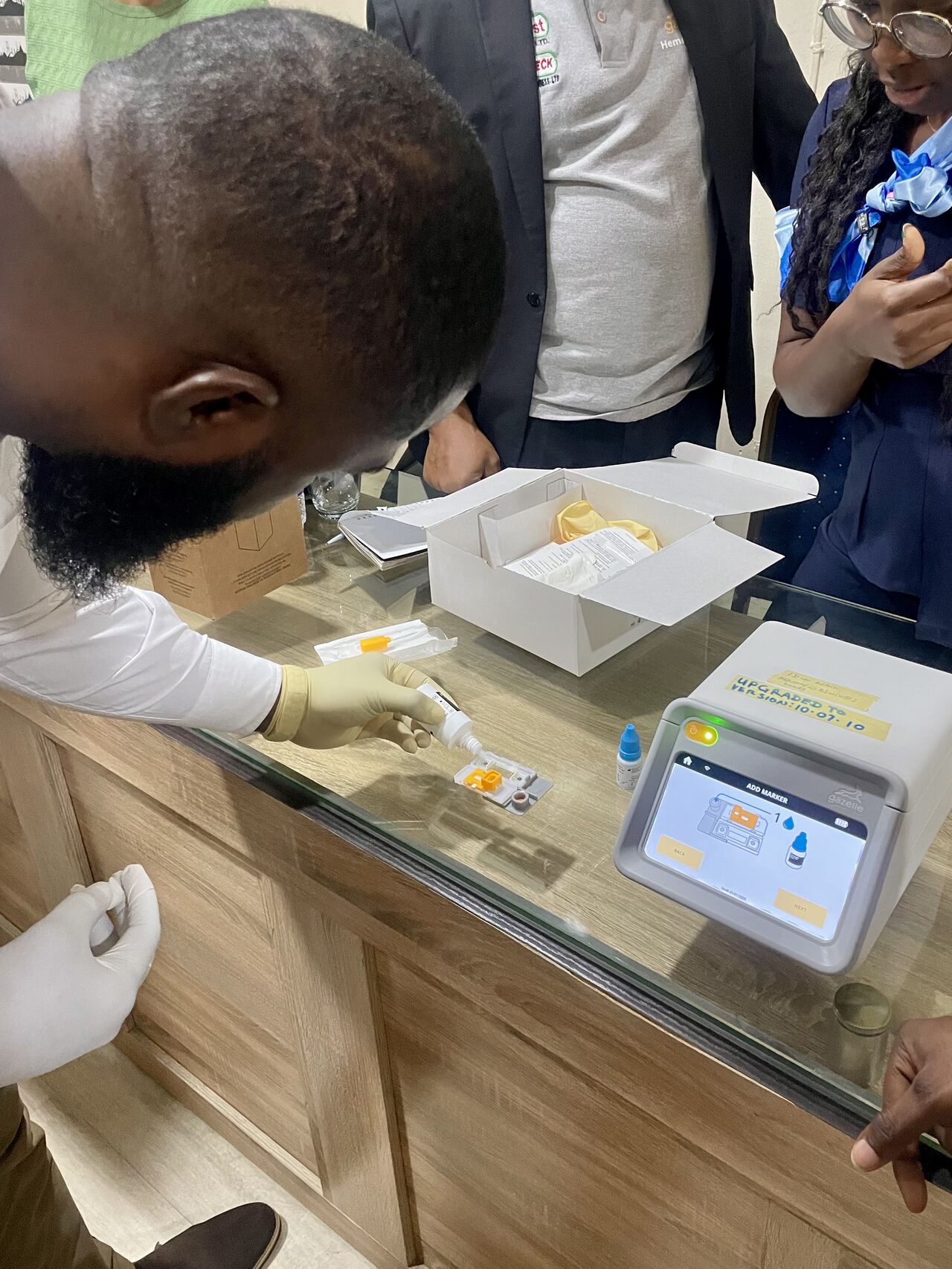
The Gazelle® diagnostic platform, launched in 2021, is a major innovation in sickle cell testing. It offers highly accurate, lab-quality results in minutes, using a simple, portable device that does not require expert training. 

It uses a small reader and disposable cartridges to analyse blood samples, delivering results in just eight minutes.

Gazelle® is accurate and easy to use in low-resource settings, and can also test for other conditions like malaria, hepatitis, and COVID-19. Clinical studies show it performs as well as standard lab tests.


The partnership

MedAccess has provided a $2.5 million working capital facility to Hemex.

Hemex will work to scale up access to its Gazelle® platform in India, the Middle East and sub-Saharan Africa.

Impact projections

SCD is a neglected area with limited global funding to support screening and early intervention. Hemex’s SCD test provides a near POC testing option that is easy to use and accurate.

The working capital facility will contribute to increased access to SCD testing through support for continued Hemex growth in India and across sub-Saharan Africa.

Lives changed

MedAccess projects that an additional six million people will be reached with SCD testing on the Gazelle® platform during the working capital facility’s three-year tenor.

Markets shaped

The working capital facility is expected to have significant market shaping impact on the sickle cell diagnostic market, and potentially impact the wider health system through increasing access to novel low-cost, accurate blood tests:

  • Accelerate scale-up
  • Encourage innovation and investment
  • Build competition.

How we calculate the impact of this agreement

Lives changed

People reached estimates are based on the public health context and expected usage rates of the Hemex Gazelle® platform.

Markets shaped

We work with partners, including donors, procurers and Ministries of Health, to track changes in health markets where our investments are supporting access to products. We monitor for changes to policy, procurement practices and supplier movement, all of which affect markets and contribute to the long-term sustainability of impact. 
 

Biovac: Vaccine manufacturing

Africa imports most of its vaccines, leaving countries vulnerable to supply disruptions and limiting regional manufacturing capacity.

In 2026, MedAccess partnered with South African vaccine manufacturer Biovac, providing a $10 million loan to support the construction of an end-to-end multi-vaccine manufacturing facility and strengthen vaccine supply security.

The challenge

Public health

Africa accounts for around 17% of the world’s population and around 25% of global vaccine demand, yet more than 98% of vaccines used on the continent are imported. This dependence on overseas manufacturing leaves countries vulnerable to disruptions in global supply chains and limits regional resilience during health emergencies.

Strengthening vaccine manufacturing in Africa is a priority for governments, donors and global health organisations, since the COVID-19 pandemic exposed the risks of relying heavily on imported products.

Market situation

Vaccine manufacturing in Africa remains a small and emerging industry. African manufacturers must compete with large global suppliers that have established production facilities, lower costs and the ability to manufacture at scale. This makes it harder for individual African suppliers to secure the long-term finance needed to expand, and harder for the wider industry to develop the breadth of capabilities required for resilient regional supply.

Much of Africa’s current vaccine manufacturing is focused on fill and finish, with fewer manufacturers covering a broader manufacturing spectrum. Building end-to-end capability, including drug substance production, can take many years and requires significant investment, technology transfer and specialist expertise.

© UNICEF/Bashir Ahmed Sujan

The product

Biovac will build a new multi-product vaccine manufacturing facility in Cape Town. The facility is expected to produce finished vaccine vials ready for use against cholera, polio, pneumococcal disease, meningitis and rotavirus through a combination of technology transfer partnerships and local manufacturing.

Once operational, the facility is expected to:

  • Produce up to 50 million vaccine vials annually, equivalent to roughly 200–250 million doses.
  • Establish manufacturing capacity for oral cholera vaccine drug substance in Africa.
  • Support the manufacture and supply of priority vaccines for African immunisation programmes.
  • Create approximately 340 skilled jobs directly, alongside thousands of indirect jobs.

© Gavi/2024/Dominique Fofanah

The partnership

MedAccess provided a $10 million loan alongside financing from development finance institutions and multilateral lenders including the International Finance Corporation (IFC), African Development Bank, African Export-Import Bank (Afreximbank), Industrial Development Corporation of South Africa (IDC), Proparco and the European Investment Bank.

The financing will help Biovac construct the new facility, install specialised manufacturing equipment, complete technology transfers and prepare the site for commercial vaccine production.

The partnership will increase vaccine production capacity in Africa, strengthening regional manufacturing and supporting more sustainable health product markets.

© UNICEF/UN0428091/Yeslam

Impact

Expected impact

  • Increased investment and innovation in African vaccine manufacturing to expand manufacturing capacity.
  • Greater regional supply security for essential vaccines.
  • Support for a more competitive regional vaccine market.

The partnership will generate significant market shaping impact by encouraging investment, strengthening supply security and helping build regional manufacturing capability.

The new facility is expected to help reach an estimated 202 million more people with vaccines manufactured in Africa over the life of the investment. MedAccess’ share of that impact is estimated at 8.8 million people.

© 2021, UNICEF / Hoang Le Vu

How we calculate the impact of this agreement

Lives changed

Impact was estimated based on the projected number of people reached with vaccines manufactured through the expanded production facility. The analysis assessed the contribution of the new manufacturing capacity over the life of the project.

Markets shaped

Impact was assessed based on the project’s ability to encourage investment and innovation, strengthen vaccine supply security and increase regional manufacturing capability in Africa.

Money saved

No direct savings are currently projected. However, vaccines produced through the facility are expected to remain competitively priced in both international and local markets.

© UNICEF/COVAX/Dhiraj Singh

Subscribe to our newsletter

Receive regular updates about how our innovative finance work is making healthcare products more affordable and accessible.

"*" indicates required fields

This field is for validation purposes and should be left unchanged.
Close